ONE PIECE OF THE PICTURE / Strategy
Into the Breach
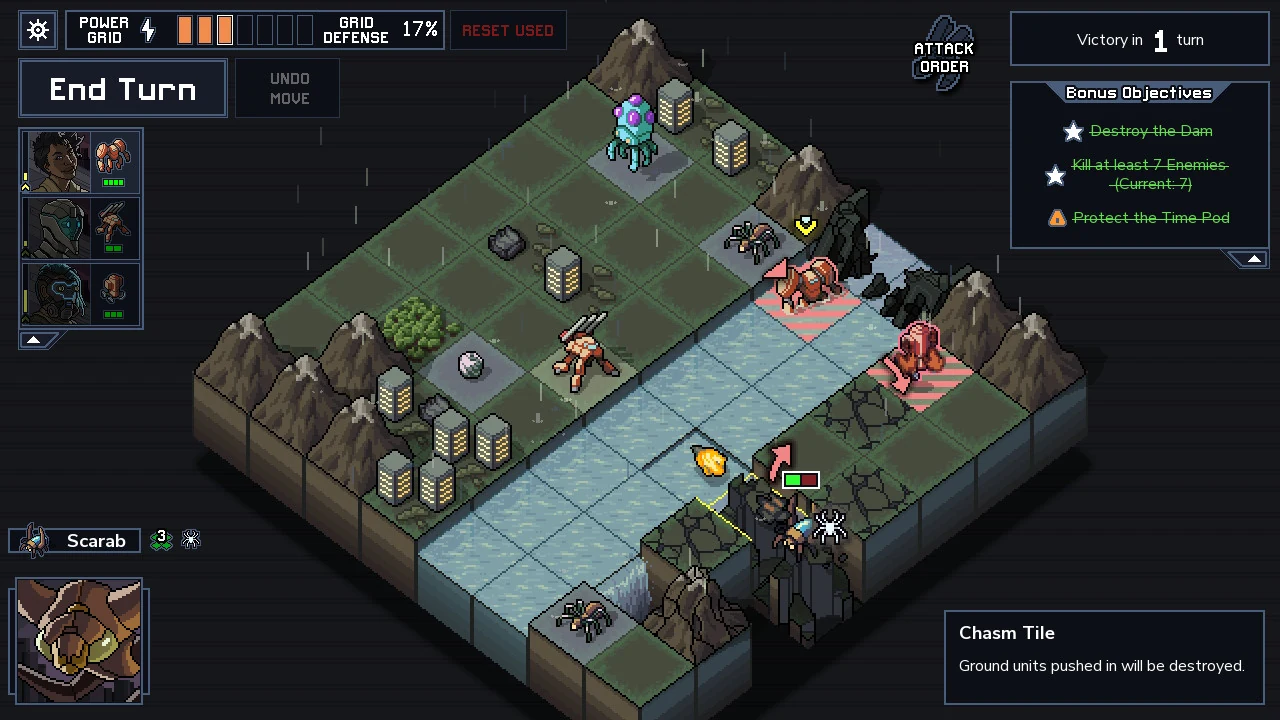
Into the Breach replaces reaction speed with responsibility: the danger is visible, and the challenge is choosing which consequences you can prevent. Small boards support unusually consequential tactical decisions.
Game facts
- Developer
- Subset Games
- Publisher
- Subset Games
- Released
- 27 February 2018
- Platforms
- Windows · macOS · Linux (Steam edition)
- Model
- Paid game
- PEGI
- 12 · Bad Language — Steam UK listing
- Players
- Single-player
- Length
- Short
- Difficulty
- 4 / 5 · Challenging
- Steam Deck
- Verified
PEGI source ↗ · Steam Deck status source ↗
Edition: Base game
The score, explained
The interest and responsiveness of the core decisions and actions.
How progression, exploration and goals fit together.
The coherence of the visual, musical and narrative presentation.
How clearly the game explains its rules and offers useful ways to engage.
The depth of optional goals, alternative approaches and reasons to return.
The First Hours
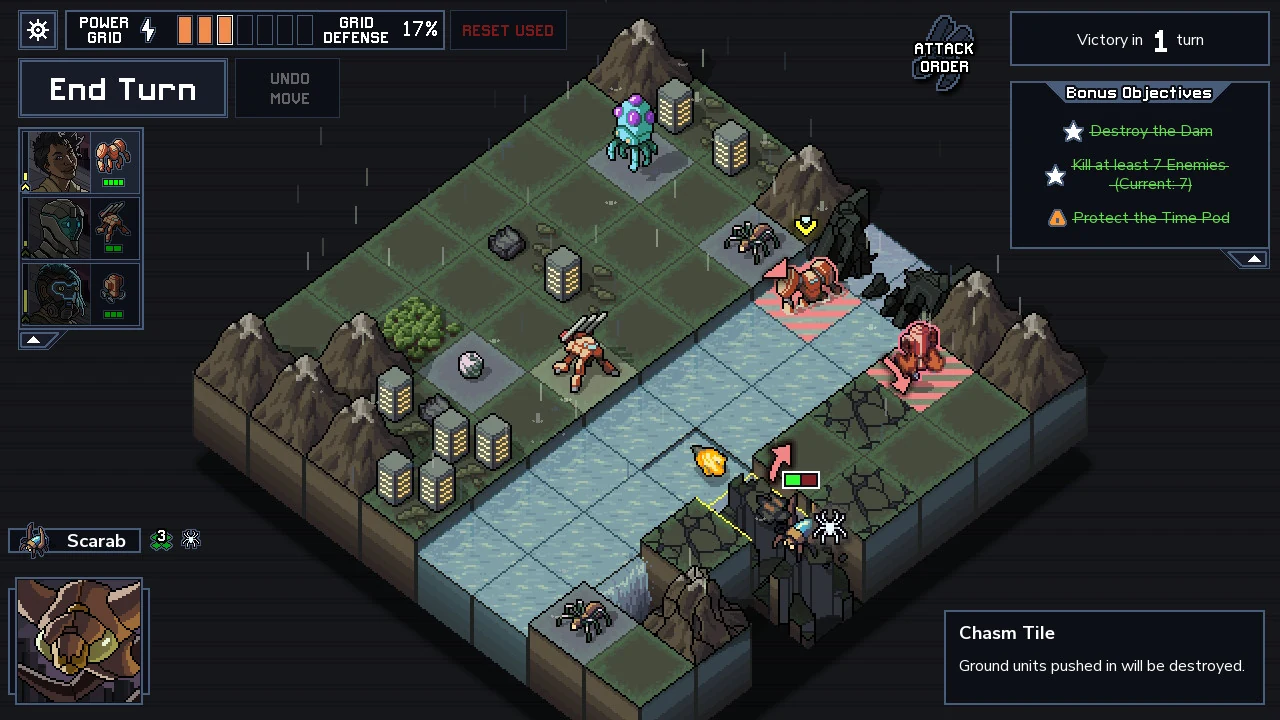
Into the Breach changes the meaning of a threatening enemy. Because attacks are announced before they resolve, the question is not simply whether you can destroy a target. You can also move it, interrupt it or arrange for its attack to become somebody else's problem. Civilian buildings and the power grid make that distinction matter immediately. Saving a mech while leaving a building exposed can be the wrong success. The small battlefield makes the opening readable, but it does not make every decision easy: a few available actions must address several visible threats. Different squads introduce different ways of manipulating that board. From the start, the game encourages you to examine the consequences of a move before becoming impressed by the amount of damage it promises.
Why It Works
Its tactical strength comes from asking several questions of one action. A push might spare a building, move an enemy away from a useful tile and create a new complication somewhere else. Since the board is compact, you can follow those relationships rather than losing them in a sprawling battle. The result resembles a puzzle with responsibility attached: finding a clever solution is satisfying because you understand what it saved. Campaign decisions and pilot development give individual encounters a larger context, while the squad choices prevent a familiar threat from always producing the same answer. Crucially, the game makes restraint meaningful. Choosing not to chase a kill can be the intelligent move when survival of the grid is the more important objective on that turn.
Where It Stumbles
Perfect outcomes are not guaranteed, and that can be uncomfortable in a game that shows its problems so clearly. Sometimes the available tools leave you choosing which loss to accept, rather than uncovering a hidden move that protects everything. Players who equate good tactics with keeping every unit and objective untouched may find those compromises frustrating. The compact presentation also concentrates attention on systems rather than extended character scenes or a richly explored world. Campaign repetition brings new tactical arrangements, but it remains repetition of the same broad duty. There is little opportunity to solve discomfort by wandering elsewhere for a while. Into the Breach expects you to stay with the board, inspect the consequences and make a decision even when every available answer carries a cost.
Who Should Play It
This is a strong choice when you want a demanding game that gives you time to think. It suits players who enjoy explaining why a move works, particularly when the explanation involves position and timing rather than the largest available attack. The small maps also make it approachable for someone curious about tactics but unwilling to manage an enormous army. Do not mistake that compactness for a promise of easy victories or consequence-free experimentation. The game is most rewarding when you accept that protecting the important objective can involve sacrificing a less important one. Compared with an action game, the pressure arrives through judgement instead of speed. Compared with a narrative adventure, its stories emerge largely from the problems you solve and the losses you choose.
The verdict
Into the Breach replaces reaction speed with responsibility: the danger is visible, and the challenge is choosing which consequences you can prevent. Small boards support unusually consequential tactical decisions.
Reasons to play
- Telegraphed attacks make plans possible to inspect
- Displacement is often more valuable than raw damage
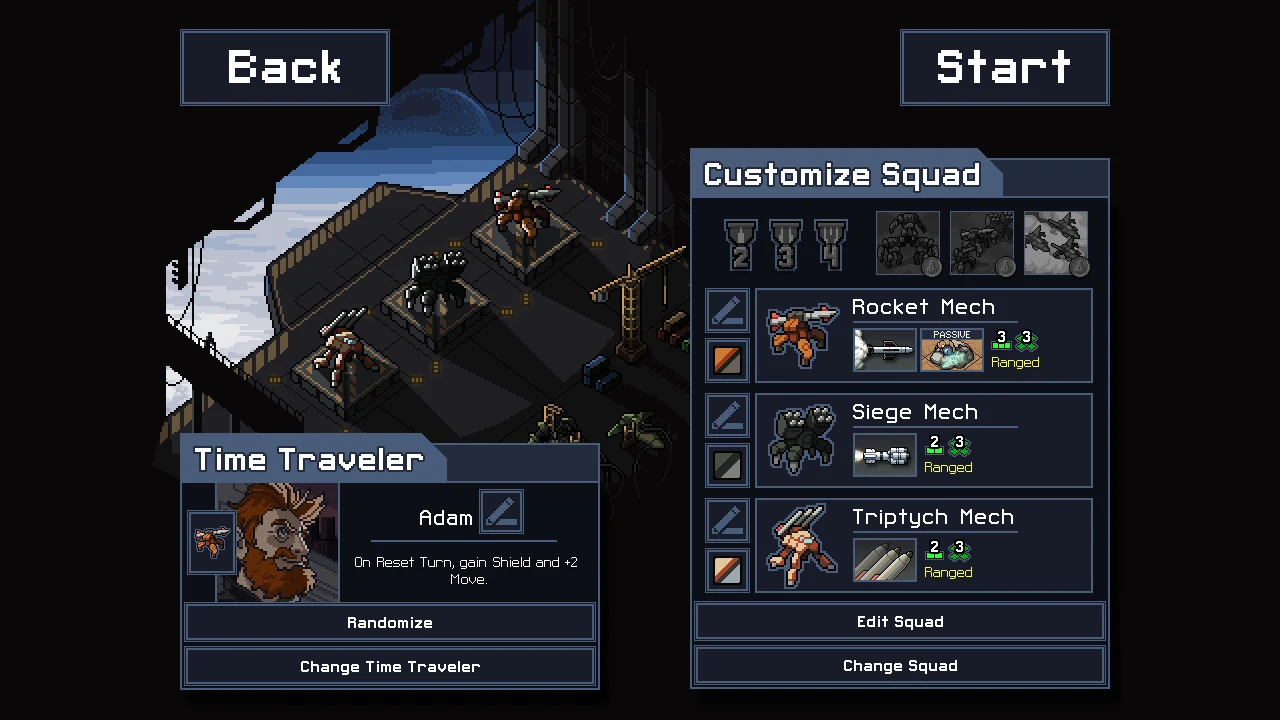
- Distinct squads change how familiar problems are solved
Reasons to think twice
- Protecting every objective is not always realistic
- Compact presentation leaves little space for character-led drama
See the game
Assist & accessibility
Explore the available settings and control options on the official game page before choosing your setup.
Parents’ guide
Players: Single-player. No in-game purchase marker in the checked Steam listing. Separate downloadable content may be sold.
Age classification: 12. Bad Language Steam UK listing
A useful starting tip
Look for a move that prevents several attacks through displacement before assuming every threat must be destroyed this turn.
A different direction
Compare this with Dorfromantik: Dorfromantik turns a peaceful landscape into a chain of small spatial commitments. Its charm comes from choosing how much optimisation you want to bring to a world that remains pleasant to arrange.
Official sources
Reviewed: November 2026
You might also like
 HadesRead review →
 CelesteRead review →
 Dead CellsRead review →